Donika Kelly’s The Natural Order of Things Reviewed by Livia Meneghin
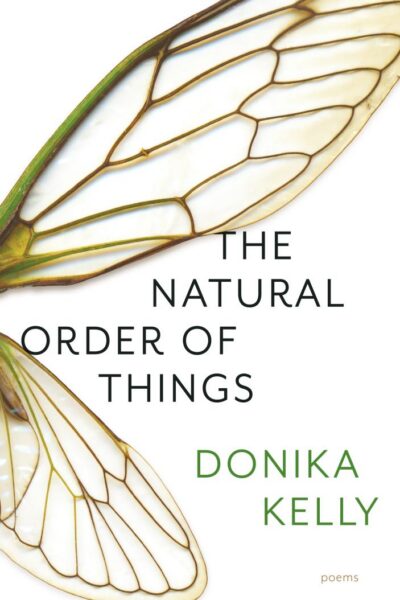
Donika Kelly. The Natural Order of Things. Graywolf Press.
Reviewed by Livia Meneghin
Donika Kelly’s The Natural Order of Things (Graywolf Press, 2025) simultaneously reaches back into lineage and looks ahead to possibility, love, and joy. With unwavering honesty, Kelly reflects inward while acknowledging connections across time and space. How do we know who we are? How do we reconnect with ourselves after trauma? Throughout this stunning ode, Kelly finds stability, hope, and the tools to thrive past survival.
The opening poem, “Brood,” immediately pulls back the veil, portraiting a writer writing. Kelly begins, “My chest is earth,” then clarifies, “I meant to write my chest is warm / but earth will do” (Kelly 3), transparently naming an error and accepting it. Further, “my chest is earth” relates the human torso—housing organs and safely pillowing a lover’s head—to the world, home to all living creatures, including writers and lovers. “Brood” continues vulnerably with similar corrections such as “beat” from “breathe” and “dirt” from “dearth” (3). Openly keeping ‘mistakes’ within a poem is an unabashedly honest craft decision; Tiana Clark does similar work in Scorched Earth (Simon & Schuster, 2025). Such subconscious connections are central to Kelly’s collection’s ethos: embracing where our minds take us as we try to piece ourselves together after trauma.
A stand-out within the collection is “Tell It Short,” in which Kelly recounts finding sanctuary after homelessness with her recently widowed great-grandmother, Miss Juel Lee. Kelly writes questions into the poem to create a conversational, trusting, storyteller tone: “And weren’t the stories / always the same” and “And couldn’t Miss Juel talk?” (12). The reader is presumed to know the answers. By contrast, the speaker pleads to be listened to and validated with the repetition of “I’m telling you,” adding urgency. Kelly writes,
“I’m telling you, I was little and lost
the season I learned to be still, to pass
a piece of time with remembering—a comfort
to remember now, to make present, for a little while,
to bring her, as from a great distance, closer.” (12)
These lines end the poem, completing the story and commenting on poetry itself as an avenue to find pockets of joy. Writing is inherently a hopeful act; poets can conjure those far away in space or time. While the natural order of things involves loss, Kelly insists that we all can find comfort in recounting our history to others.
Multiple poems within The Natural Order of Things share a title. Three poems titled “The Bone Museum” respond to art, time, and inheritance by considering what we are made of and how are we preserved. In the third of this set, Kelly confronts past and present: “Is this the beginning or the end” (34). To answer with the former is future-oriented and hopeful but risks ignoring those who are already buried. To answer with the latter embraces hope in a different way by acknowledging ancestors as protectors. Kelly writes, “Reliquary of wax, yes, and bronze / and who have we walked over to be here? // Who among my siblings cares for the hall, / for the bones?” (34-35). In accepting one’s place in the hall of bones, the speaker here announces a responsibility to remember the past and to protect future generations. In the first “The Bone Museum” poem, Kelly writes, “I didn’t come for the bones / but for the ripple of kinship” (7). The water image evokes movement, connection, and family born from all of the beings and choices that have come before. Wax and bronze immortalize what would otherwise be lost, preserving their form. Poems do the same work.
Kelly writes of love’s expansiveness, gifting readers permission to take up space to process their own journeys. In “The moon rose over the bay. I had a lot of feelings.,” the speaker, Kelly herself, observes dead squid on a harbor beach:
“I imagine the tide simply went out
without them. I imagine they cannot
feel the black flies charting the raised hills
of their eyes. I write my name in the sand:
Donika Kelly. I watch eighteen seagulls
skim the sandbar and lift low in the sky.
I pick up a pebble that looks like a green egg.
To the ditch lily I say I am in love.” (Kelly 23)
What Kelly notices externally is balanced with her imagination. Visualizing is an act of empathy with each creature cohabitating the shoreline. By writing her name in the sand, Kelly records her presence among them, even though she knows the letters will eventually fade with the elements. She crescendos to the proclamation of love repeated three times in the poem, addressing both the man-made and the nature-made: a Jeep, roses, a house. All share the same plane.
“What Is The Measure,” nearly forty pages later, continues this declaration of love. The world—including all of its living creatures—cannot and should not be seized, and still, poets reach towards life with immeasurable love. After saying “I submit” three times (60), Kelly addresses her beloved:
“Your arm, nearly as long as mine, your palm,
wider, your mouth a beginning, your eyes, of course,
that against which everything is measured.
You harrow and the summit writhes;
your broad foot falls, and the field, akimbo, gives up
its gravity, lets loose its bodies its bones,
thrums an animating light.” (61)
The speaker tenderly considers each body part alongside their own without judgement. The world feels safer with an instrument of understanding that largescale landscapes like mountains or fields fall short of, that frees the bones of ancestors, and that radiates aliveness.
With The Natural Order of Things, Kelly permits inheritance, earth, and love to permeate her being. With intimate looks at family via vernacular and memory woven within meditations of the cosmos via the body, Kelly articulates a natural order of things without pretention or any demand of praise in return. She uplifts love—for oneself, for our beloveds, for our neighbors including all animate beings, and for the world—and gently but confidently reminds readers that hope is ahead.

Livia Meneghin (she/her) is the author of feathering and Honey in My Hair. She is Cofounder and Managing Editor at Two Cardinals Literary. At Sundress Publications, she serves as Assistant Chapbook Editor. Livia has been awarded recognition from the Academy of American Poets, Breakwater Review, The Room Magazine, the City of Boston, and elsewhere. Since earning her MFA in poetry, she teaches writing and literature at the collegiate level. She is a cancer survivor.