Fall 2026 issue now available
The weather is getting cooler in Lincoln, and with the changing season comes our latest issue! Fall 2026 features a portfolio of Latinx Flash Memoir edited by Joy Castro, Prairie Schooner‘s Nonfiction Editor. Contributors to the portfolio include Sandra Cisneros, Ana Menéndez, Rigoberto González, Daisy Hernández, Luis J. Rodríguez, Ángel García, and many more. In her introduction to the portfolio, Castro writes:
During a time of intensifying carceral peril and state violence in the United States—a time when political rhetoric is distorting, erasing, and dehumanizing many groups of people in order to lay the groundwork for our incarceration and expulsion, a time when ICE is breaking records for deaths in custody—literature still offers us the power to write back, to testify, to offer an alternative version, to leave a different record, to archive our resistance. All of us are threatened when the foundational principles of a livable society are attacked. Literature lets us say no. Lets us say something else entirely.
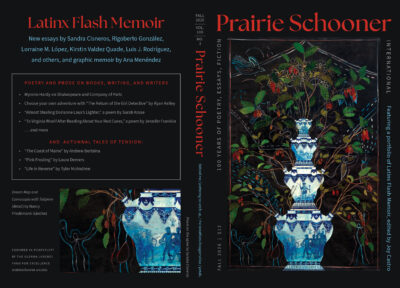
For the issue’s cover, we’re excited to feature Dream Map and Cornucopia with Tulipiere by Nancy Friedemann- Sánchez, whose work is also featured in an eight-page folio inside the issue. In her artist statement, Friedemann-Sánchez writes:
Anchored in feminism, my art is informed by North and South American cultural forms that fuse and cross-pollinate. My practice is a bicultural and transcultural experience; it speaks of difference, of opposites: having grown up in Colombia and having migrated to the US as an adult. I make art in two languages about the experience of physically having moved yet remaining rooted in Colombia. I create visual expressions of that hybridity and syncretism that has taken place since the conquest of the Americas and that is replicated in the migration experience.
The fall issue also includes fiction by Andrew Bertaina, Laura Demers, and Tyler McAndrew; essays by Monmita Chakrabarti, Myronn Hardy, and Ben Perkins; and poetry by Jennifer Franklin, John Kinsella, and David Joez Villaverde, among many others.
See the full table of contents and read excerpts from the issue here. Ready to order a copy? Head over to our online store.