We, The Kindling: Otoniya J. Okot Bitek in Conversation with Ber Anena
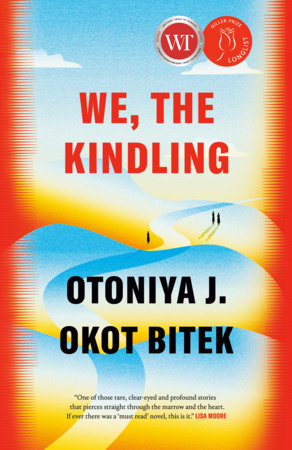
For two decades, starting around 1987, the Lord’s Resistance Army rebels led by Joseph Kony waged a war against the government of Uganda under President Yoweri Museveni. The rebellion, which started in northern Uganda, spread to South Sudan and the Central African Republic, leading to the killing of more than 100,000 people and displacement of close to two million others. In 2003, the UN undersecretary for humanitarian affairs described the northern Uganda war as “….the biggest forgotten, neglected humanitarian emergency in the world today.” Otoniya J. Okot Bitek’s debut novel, We, The Kindling, is based on that dark period in Uganda’s recent history.
Ber Anena (BA): First, I enjoyed reading this book immensely. A story about the Lord’s Resistance Army War (at least as a long work of fiction) was overdue. Well done and congratulations! Why was it important for you to write this book?
Otoniya J. Okot Bitek (OB): Thanks so much, Anena. It means a lot to me that you read it and spent time with the text. It took as long as it needed to get done right—there was a lot of re-writing and doubt—but it has also always been important to me that there’s not yet enough Acholi voices writing about this (or any time) of our history. Fiction eventually settled as the form for this book to take, and I’m glad for it.
BA: We, The Kindling is told as stories within a story. The use of folklore and stories of the women’s everyday lives are central to the book’s narrative. Tell us about this stylistic choice.
OB: I wanted this to be a book about storytelling. Storytelling gathers people but it is also a form that allows for people to work through what happened to them. This also offers me a way to think about the ethical dimensions of sharing difficult subject matter to an audience (or readership) who you might not know in advance. As a practice, storytelling is as old as humanity, I think, so I was tapping into an old and tested technology for holding stories and sharing experience.
BA: What did you want the reader to take away from how you use language and even names in the novel? Aside from English, there’s Acholi, Lango, Luganda, and Swahili interspersed in the narrative. Was this meant to speak to your multicultural background?
OB: Not really. It’s not about me at all. I did want to gesture towards a community of people who are inherently multicultural. We have the gift of many traditions jostling and enriching each other. All the languages you list above are commonly spoken by many people in that part of the world, so I wanted to echo the contemporaneousness of Acholi while also gesturing towards the idea that this is a Ugandan story and an African one, too.
BA: Related to the above, I was intrigued by your use of symbols. For instance, instead of referring to the LRA fighters as rebels or lukwena as they were commonly known, you interchangeably call them Ogre, Catfish, and Guinea Worm—some of them characters in Acholi folklores. Besides the folklore, I’m curious if you were aiming to achieve something more with the creature allegories.
OB: I hope that when you read the book you’ll come away with the knowledge that these creatures are not just metaphorical. Our folklore holds wisdom and sometimes they hold history, so when something is happening around us, it’s relatively easy to find a story that reflects the reality. These creatures also stood in for people who might otherwise have been caricatures if I tried to write them out. In the case of the guinea worm, I needed to have a witness to the lives of that family which was not possible as a person.
BA: Spirituality plays a big role in the novel. In the case of the abducted school girls from St. Mary’s College Aboke, we see Sr. Rachele going to the bush to plead for their return. I remember that within the rebel movement, Christianity, Acholi spiritual beliefs, and at some point, Islam, were championed by Joseph Kony and his followers. In the novel, God and spirituality do not always mean unity or equal treatment. Prayers were, for instance, held for the Aboke girls more than other abductees and the rebels used their spiritual beliefs to inflict harm on their victims. What did you want the reader to mull over as they encounter spirituality or religion as portrayed in the novel?
OB: Spirituality and religion have always been important to us. I was brought up to be prayerful and there’s a prayer for every kind of situation, but I also wanted to illustrate that prayer by itself, as practice, was not always enough. For sure, religion has been co-opted and politicized and so it was a little messed up to see how godliness was not a thing in those situations. However, prayer offers comfort, and sometimes religion can offer meaning to people, so it was important to me to show that, too.
BA: One of the stylistic devices you effectively use in the novel is repetition, which gives the book a haunting but also musical, lyrical feel. Is this your poetic side at play or perhaps a homage to the Acholi oral tradition?
OB: Probably both.
BA: In the story of the LRA war, I’m always intrigued but also devastated by the victim vs perpetrator dichotomy as well as the grey category of victim and perpetrator. We see abducted children become killers and victims become targets of stigma and discrimination when they escape captivity. Could you speak a little more about these contradictions and complexities in the character of the war and the people affected by it?
OB: What I knew as the war between the government of Uganda and the Lord’s Resistance Army is now commonly referred to as an insurgency, which suggests that it was the matter of a weak guerrilla army poking at a mighty government, but what happened in northern Uganda took more than two decades and there was devastating suffering and loss. This was a situation in which thousands upon thousands of children were kidnapped and raised to be fighters against a government that they were not old enough to understand themselves as citizens of. They fought largely in their own homelands and most of the victims of that war was their own kin—it was grievous and complicated and no one bore the brunt of it more than the Acholi. Who was to be held responsible? It was mind-bending to think about kidnapped children as enemies, especially when thinking about the families from which these kids were taken. The greyness of the victim perpetrators is even more complicated when you think about the next generation of kids who are now adult and want to understand what happened to their parents—with what clarity can this situation ever be presented? Of course, we know about Dominic Ongwen, indicted by the ICC for crimes against humanity, and there’s no denying the crimes he committed. He himself was kidnapped as a child—what is the state’s responsibility to ensure the safety of its citizens, especially the children? I think it’s much simpler to point fingers at individuals and have them pay for crimes that were committed in the two+ decades of that war than it is to think through the larger dynamics that one can trace from the slave trade in the 19th century, through to the horrific experience of British imposed colonialism, the two world wars, the struggle for independence, and the disastrous subsequent post-colonial governments. There are so many stories that still have to be told as we figure out this particular time in the history of Uganda, and Acholi in particular.
BA: Tell us more about the book’s title.
OB: For a long time, I had a different title and so “We, the Kindling” as a title emerged during the editing process after having submitted the manuscript. It’s a much better title than what I had before, but it also focuses the experiences from the perspective of the we, the girls who were kidnapped by the LRA. When the war ended, survivors and returnees were obligated to carry a card stating that they were “forgiven” by the government. Some of them asked: why did the government not protect us? Who should be forgiving who, for what happened to the young people who were kidnapped and forced into atrocious situations? “We, the Kindling” is also a chapter title from inside the book which features a reflection from the voice of someone trying to make sense of what happened to them.
BA: The book is based on quite a heavy subject—war—and as someone from northern Uganda, you must have had moments of triggering recollections. As a reader and someone who grew up during the war, I was transported back to certain moments. I also felt a sense of pride that this story is out in the world. What was the writing experience like for you and how long did it take?
OB: I did not live in Uganda during the war, although I have some lived experience of war in Uganda. It was very difficult to work through these stories but it’s not, I don’t think, because I was triggered. Although, I appreciate that it’s triggering for folks who lived through it. For me, it was very challenging to work with stories of people, many who are my kin, and know that these were their lived experiences. I needed to do my utmost to honour these women even as I was enveloping their stories into what readers would read as fiction. That was also very hard but I’m proud to have seen the book through.
BA: You have been primarily a poet. I’m curious about the experience of writing the novel compared to the poetry collections or short stories you’ve written over the years. A keen reader of your work can tell by reading the novel that you’re a poet. How did it feel switching to the long form?
OB: Long form writing is very different (of course) to the poetic form. I guess the fact that most of these chapters are very short betrays my practice as a poet. I’m also an avid reader and I love reading fiction, so I can appreciate a good story, and I wanted very hard to write a good story. Even though most people who are familiar with my work will think of me as a poet, I have dabbled in short fiction for a long time, too, so I wasn’t really switching form by writing fiction, but for sure, it was the first time I was out in public as a novelist.
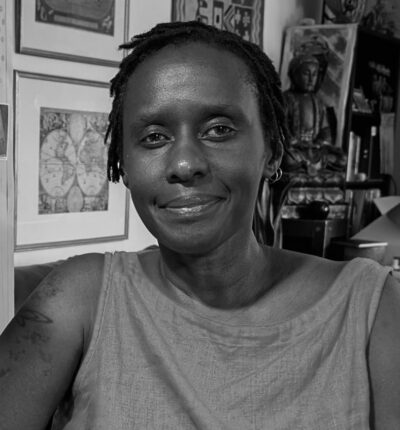
Otoniya Juliane Okot Bitek is the author of three books of poetry. We, the Kindling, her first novel, is published by Alchemy, an imprint of Penguin Random House.
Photo Credit: Seasmin Taylor
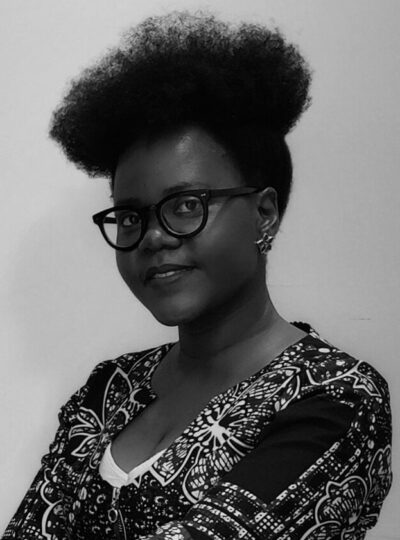
Ber Anena is a writer from Gulu, Uganda. She is the author of A Nation in Labour, a poetry collection that won the 2018 Wole Soyinka Prize for Literature in Africa. Her memoir, The Lies We Tell for America, will be out in November 2026 from Flatiron Books, an imprint of Macmillan. Anena graduated from the MFA Writing program at Columbia University in 2021 and is pursuing a Ph.D. in English at the University of Nebraska-Lincoln where she has been awarded the Vreeland Prize for Fiction and the Susan Atefat Peckham Prize for poetry.
Photo credit: Sreeraghavi Mani