“A feeling that leads to action and work”: An interview with Summer Farah
by Marlin M. Jenkins
The following interview with Summer Farah, conducted by Marlin M. Jenkins on September 15, 2025 over Zoom, has been edited for length, sequence, and clarity. Farah’s debut collection The Hungering Years is now available from Host Publications.
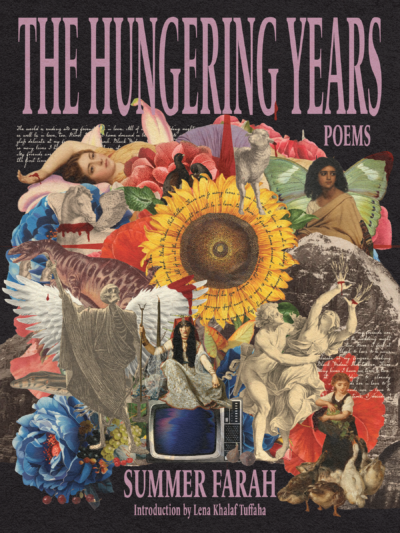
The Hungering Years by Summer Farah, published February, 2026 by Host Publications
Marlin M. Jenkins (MMJ): What are your hopes for this book in the world? Do you think about it in terms of This is what I want The Hungering Years to do? How are you thinking about having the work in the world in a new way with a full-length collection?
Summer Farah (SF): I’ve been thinking a lot about why am I doing this? Outside of the fact that I had a book that I put together, and I would like for it to be an object. I think all attention is an opportunity. I like to channel that attention into hopefully motivating people to do work. I raised a lot of money for people in Gaza when I was touring with my chapbook I could die today and live again. I was able to leverage that attention towards mutual aid and towards education on PACBI and BDS, and broader education on Palestine.
Something I’m really hoping I follow through with on The Hungering Years tour is to reach out to Mask Blocs and clean air clubs in whatever cities I visit and invite representatives to come to whatever bookstore or space that I’m at to talk about the work that they do in mitigating spread of virus, and cleaning our air, and taking care of people, and keeping people safe. So that’s, you know, it’s just an opportunity, when I have an object and people are inviting me into spaces because of that object. What kind of world can I build within that room? People are coming to see me, theoretically, and what can I ask of them in return, outside of buying the book?
MMJ: There’s a moment in the book that I really love in the poem “noooo don’t be a birthright apologist you’re so sexy ahha”: “solidarity is not sympathy, it is work.” I’m curious about how poems do or don’t fit into that solidarity. What do you hope that the poems can contribute to solidarity, and what do you think their limitations are?
SF: I’ve been thinking about it a lot, especially in the last two years in the escalation of genocide in Gaza, and I think that there is a lot of hand-wringing and people saying, oh, don’t you just feel so bad for the Palestinians? And I want people to feel things, right? And I want them to be moved to do something from that feeling, but feeling oh-so-sad is just not really helping anyone, neither people experiencing a genocide or yourself. And I think that a poem can energize, it can motivate. It can be fuel, it can be articulation for a feeling, a feeling that leads to action and work. But it’s not necessarily work itself. There’s value in a poem to point to a moment, or a phenomenon, or a history. But it has to go past I’m having feelings about this. After you have felt, what is it you will do?
MMJ: Part of what I was most struck by in The Hungering Years is that there’s this incredible sense of longing—and sometimes loneliness, but sometimes just aloneness—but there’s also things that keep you company. There’s the kind of literal company of poems that involve friends or loved ones, but then also the company that’s kept through all of the people you’re in conversation with. When you’re writing, how are you thinking about that interplay between isolation and company?
SF: I think a lot about writing and its reputation as a solitary process. Even though I do write alone for the most part, it doesn’t necessarily feel like a lonely activity. I think the writing communities that I have been in are very encouraging of the collective, of doing things together. My first writing space was slam, and it was quite literally, You write things together, you are a team, you have group pieces—the act of writing is often in service of a collective.
The act of reading for me has always been about company. I like spending time with a book and feeling like I am being told something, like someone is sharing something with me. My favorite poets have a sense of intimacy. Even when there is distance, or confusion, or bewilderment, I like the feeling of conversation between reader and writer.
Similarly, television was often that for me, too; I was a weirdo who didn’t know how to hang out with other people, really. I’m extroverted, but I have social anxiety and other types of issues, and so it’s a very interesting tension within myself. I want to be among people, but there are certain obstacles within that, whether it be social or pandemic or distance and things like that. And I found a lot of friendships through the act of loving and discussing television, and so I think writing is very hand-in-hand with that process.
MMJ: Thinking more about the things and people you’re in conversation with, I’m curious what recommendations you have for things that have informed the book that you think more people should check out.
SF: I don’t think you need to know anything that I reference, but Etel Adnan’s Journey to Mount Tamalpais is probably the text that drove the “I tell Etel Adnan” series of poems in the book the most. It is a beautiful text about obsession and fixation and this sort of consideration of a distant object that cannot reciprocate. Reading that book, I was like, wow, Mount Tam is to her what Supernatural is to me. It feels so goofy, but there is this way in which she talks about the mountain as her friend, the way that it is a return that she wants to make sense of, the way it drives her creativity, it drives her intellectual rigor, the way she brings in other art objects to it. She talks about painters that inspire her as if they were right alongside her. And so I felt so energized by reading it, both because it’s something that I had already been doing in my work, but also because it sort of affirmed the things that I’ve been doing, and it dictated how I wanted to move forward. So that book, apart from being quoted in my book, I think was a good companion.
Should people watch Supernatural? I don’t know. It is the most relevant thing to me in my writing career, ever. It is an essential text for the book. Both my relationship to poetry and a lot of the friendships within the book are possible because of Supernatural; a lot of my investments and interests spawn from that kind of formative moment in which it was my favorite show as a teenager.
And I think Supernatural is probably the biggest text throughout the book that I had the most contentious relationship with. It is a show that just celebrated its twentieth anniversary, and I did get the twentieth anniversary edition of the TV Guide, and when you see the very large, beautiful artwork of the characters across the series, it’s mostly white people; it might be 100% white people. And this is a writer’s room over the course of fifteen years that I know very well. There’s, like, one woman of color in the fifteen years of that show existing. And, yeah, pretty misogynistic, pretty racist.
When I talk about the kind of failures of the show, I’m mostly just interested in tensions and contradictions produced in the narrative itself. And sometimes, I think racism and misogyny can be craft failures. It can make your narrative not work. As well as homophobia. Homophobia is a big one, in Supernatural in particular. But I still return to it because of its early impact on me, and I find my relationship to it to be a poetic generative space in this return as an object that I often think about when I’m working with other art, or just living in the world.
MMJ: In the book there’s this reverence to Adnan, this reverence to friends, and otherwise it feels more like, here is this thing that’s important, that’s formative, let’s talk about it, right? Like, this deserves space and conversation. I think wrestling with those complications felt really apparent, and really meaningful and worthwhile.
I think that it’s a really important part of conversation, what you’re saying about how the politics of a piece of art are inherently related to its craft.
SF: I’ve been reading literary theory, as PhD students are wont to do, and I read a piece by Leon Trotsky about criticisms of Russian formalists, and how the sort of theory, the argument of formalists is that the way to look at art is only by its formal craft parts. And his argument is that a person made that art object, so no matter what, the art object is informed by the politics that surround that person. It may not necessarily be evident or about that in the object itself, but it is informed by the lived experience of a person.
And, you know, this is something I knew intellectually, but it very much resonated with me, and it made me think a lot about a line in Solmaz Sharif’s “Look” about washing dishes, while a lover… I should find the line …
MMJ: I think it’s something like, “what was political about this moment?”
SF: Okay, it’s in her craft essay on erasure—
“A lover, once: You can’t say every action is political. Then the word political loses all meaning.
He added: What is political about this moment?
I was washing his dishes. I had left the water running.”
What do we fail to consider because of how our environment has built us? And what can I stomach because of my privileges and my experiences? And am I okay with that in myself? Am I capable of critically engaging with something to the point where I create new boundaries and expectations for art and how I spend my time in general?
MMJ: With poems and starting a new PhD program, and creating spaces and all that, how do you take care of you in the midst of it?
SF: Something I’ve been thinking a lot about is how much aggression and frustration I hold for my past self, in the ways that she’s wasted time, or made mistakes, or made the wrong choices, and it’s very not fair to myself, but it is the truth. I am often frustrated with the person I was a week ago, or a few years ago, or longer. So at the end of each day, I think, What can I do to take care of tomorrow’s Summer? So I wash my dishes, I make sure I prepare overnight oats so I have something to eat in the morning when I really don’t want to prepare something otherwise, I take out the trash so I don’t have to think about taking out the trash the whole day and not wanting to. That’s been a good practice, in just asking myself, What is it that you can do now that you don’t want to put off to make things harder for yourself tomorrow? And that’s been really helpful. It’s also included, like, don’t watch another episode of Dawson’s Creek, you know? Leave some for tomorrow-Summer.
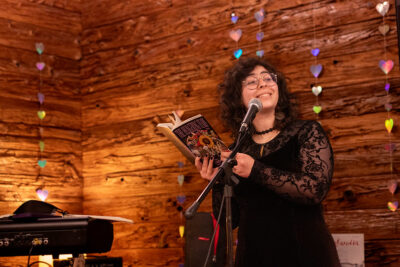
Summer Farah is a Palestinian writer and critic based in California. She is the author of I could die today and live again (Game Over Books, 2025) and The Hungering Years (Host Publications, 2026).
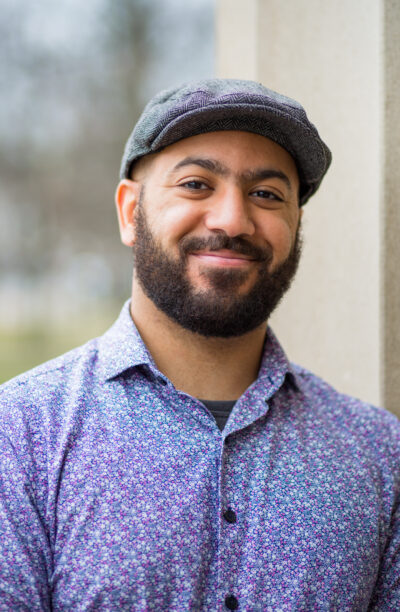
Marlin M. Jenkins was born and raised in Detroit. The author of the poetry chapbook Capable Monsters (Bull City Press, 2020) and a graduate of University of Michigan’s MFA program, their poems, stories, and essays have found lots of good homes online and in print. They currently live and teach in Minnesota.