Meet the Editor: Folasade John
In this Meet the Editor series, we’re asking our assistant editors about their work on the Schooner and thoughts on their respective genres. Read our sixth installment with assistant fiction editor Folasade John below.
Folasade John
Assistant Fiction Editor
What brought you to UNL and to working with the Schooner?
I came to UNL to pursue a PhD in creative writing, and it felt important to me to contribute to the Schooner in any way I could. Being here has made it so clear that literature is produced by people obsessed with and dedicated to the craft of writing and a community of writers. I wanted to be part of that.
What do you look for when reading submissions?
I’m often questioning what work this story is trying to do. Why does it want to do this work? Is it accomplishing it? Does that work lead us somewhere new? To a new emotion, thought, image, etc.? Does it stick the landing?
Can you recall one piece you were moved by and why?
There was a piece about two women and their experience of gender based oppression in the early days after the end of slavery. The language in the piece was lovely, with dialogue in dialect. The thing that stuck with me was the friendship between the women that endured despite their changing circumstances in the strange new time.
Has working as an editor for Prairie Schooner impacted your own creative work?
I’ve gotten a much better sense of what I want my own work to do in a reader. Reading so many stories, you refine your senses in the same way you do when tasting wine. It becomes so much easier to think, this is what I like to read and distinguish this from this is what I want to do with my writing. I also feel so much less worried about the reception of my work, thinking how many tired editors there are out there staring down a Submittable queue!
What draws you into a short story?
I’m often drawn in by unusual juxtapositions. The tension between the diction and the subject of a story. The thing that is just a bit off center, which opens up the story to do something unusual or to make me think about its subject in a new way.
How do you balance narrative clarity with artistic risks?
This is a bad question for me since I don’t find narrative clarity that important with what I want to do with my work. When it has been more important, I’ve tried to balance the complexity of the risk I am taking with more pared-down language.
What would you like to see more of in contemporary fiction?
I would like to see more experimentation! There is a lot of room out there for things that have never been seen or explored before, and I would want to see more of that. I want to be surprised!
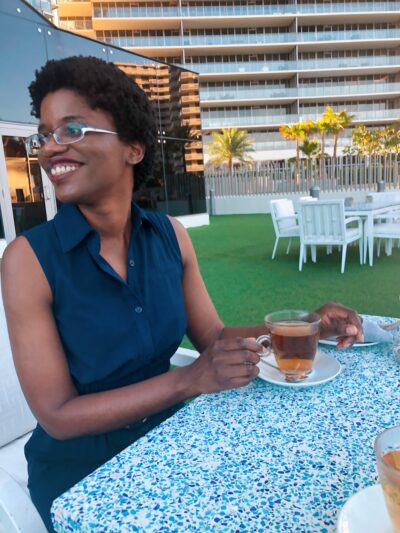
Folasade John (they/them) is a Black queer Trinbagonian writer. Their work is forthcoming or has been published in Fourteen Hills, QWERTY, filling station, and Stanchion.