The Consequences of Adulthood: An Interview with Rachel Khong
by Marjee Chmiel
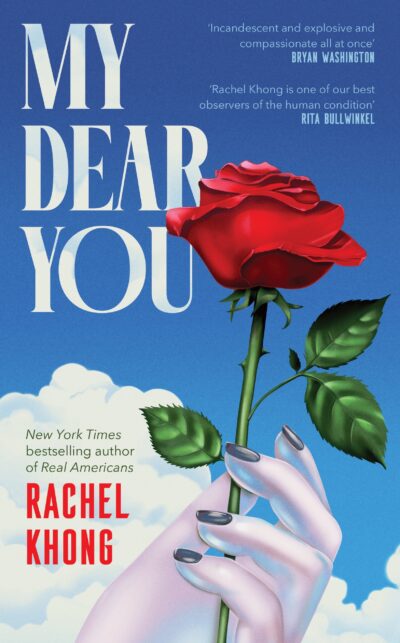
If fairy tales were recreated from first principles in the twenty-first century United States, I suspect they’d resemble the short stories from Rachel Khong’s collection, My Dear You. Each story is anchored in a question that is at once intimate, universal, and timely: What happens when your past creeps into your present? What if—one day—everyone literally stopped “seeing race?” How much of yourself would you keep in the afterlife? With fresh premises, sharp humor, and pristine prose, I consider a Rachel Khong short story to be a celebratory event. Upon the release of this collection, I was eager to learn how young Rachel-the-reader shaped the current writer and how creators can protect their own lovely weirdness. In our conversation, we discussed the stories of our youth, the role our bodies play in the physical act of drafting, and the endings that haunt us long after the page is turned.
Marjee Chmiel (MC): Tell me about Rachel at age eight, twelve, fifteen? What was she reading? How do you see those stories coming through in your work now?
Rachel Khong (RK): Fairy tales were such a big part of my childhood, in whatever form I could get them in. There was this Japanese anime television show that I really loved, called, I think, Grimm’s Fairy Tale Classics. It was a cartoon where they animated a bunch of Grimm’s fairy tales. Everything becomes part of me somehow, kind of in the way food becomes part of me. I read voraciously as a child, and reading sort of agnostically, reading anything that I could find.
The stories that I gravitated to as a child were fantastical or dreamlike, and I love that kind of writing. I had many teachers who really valued realist writers, and I appreciated that, but now, coming into my own as a writer . . . I think writing is more interesting when you use everything in your capacity. I wouldn’t have fun writing strictly realist or strictly fantastical stories.
MC: I often hear that when theme is done well, it’s a question. Your stories in My Dear You would be my dictionary definition of theme-as-question. At what point in your process does theme emerge? How does it inform the other decisions that you make in your storytelling and your prose?
RK: I don’t really think themes are for writers, actually. I think themes are for the reader; the reader can surface what the themes are for themselves. When I’m writing, I don’t think of theme. Theme comes from a sort of intellectual place. It sounds weird to say, because writing obviously does come in part from your mind, but I think it comes from more than that. It comes from your body. It comes from everything you’ve experienced. It comes from just these really deep questions that you have, a question that I can’t let go of. And it’s beyond interest, that tangle of the questions and fascinations, that tangle becomes what I write.
MC: I can see that so clearly in the title piece of the collection, “My Dear You.” The story poses the larger-than-life types of questions I preoccupied myself with as a child, things like: Will I get bored in the afterlife? How old is everyone in heaven? The story takes us through these very painful reflections and questions around the implications of love and memory.
RK: That story is about so many different questions, like the fact that relationships are built on memory, which itself is so faulty and so porous. But I was also just really interested in the question of what makes a “successful” relationship? What is marriage for? You have me thinking about childhood. When I was a kid, I remember having nightmares about marrying the wrong person. It just felt so big, those really big adult decisions. Things felt so consequential to me as a child. In some ways “My Dear You” is about the consequences of adulthood. It’s very deeply rooted. It’s like, is there even a “perfect person?” It was all of those questions that had come from this really deep place.
MC: I read your interview in Alta, about workshopping “My Dear You.” You got the feedback to take out the racist dog in heaven. That it came out of nowhere. But you advocated for keeping the dog in the story because you believed this was true to the protagonist, to the way she experienced the world and the things she would notice. What insights could you share with other writers about how to balance feedback and writing in community with the preservation of one’s own idiosyncrasies and weirdness?
RK: I don’t know that workshop is the right way to go about things, especially for work that’s at an earlier point, if someone’s just starting something. I think that you should protect that thing that wants to grow and not cut it down too quickly. It’s just a little sprout that’s trying to get some sunlight. I think you should build a fence around it.
My friends and I, we teach in a collective, and we use something called the critical response process that was developed by Liz Lerman. She talks about moving away from piling on criticism and moving towards asking and being aware of what the creator was going for. The process of finding your own way as a writer has so much to do with paying attention to what feels right for you and what feels right for your writing. It’s more than an intellectual exercise, it’s a bodily one. You can feel when something is right, attuning to that and keeping in touch with it every day. Every time you write, underline a sentence that is the most true to you. Collect those sentences.
Often we’re doing a lot of throat clearing in our own writing, and if we can find the parts that strike us as the most sort of true and unguarded, that is so much of the job of writing. It’s a practice, it’s not something that you could decide to do one day. You have to constantly be practicing. What do I actually want? What am I actually interested in? What feels right to me? Hear feedback from other people, be interested in it, but don’t let their values become yours.
I once heard this quote from Andrew Sean Greer, who was quoting Daniel Handler: When you’re getting feedback, you think whoever is giving feedback is the doctor, and they’re telling you exactly what’s wrong with you, they’re giving you the prescription. But really, the reader is the patient. They’re describing their symptoms. It’s up to you to decide what’s going on there. It can help to just be curious about where the feedback comes from, why the reader is feeling that way. There are so many different ways to read one piece of work. Now that I’ve had several books out, it’s fascinating how many perspectives can change the stories themselves.
MC: The stories in My Dear You all end on an echo. I read an interview with a writer who talked about wanting their stories to haunt people. That described my relationship with your endings—they linger. At the same time, you end when there’s nothing left for the protagonist to “say.” How do you find that moment in which there’s nothing left to be said, and yet there is an opening where your readers linger?
RK: I love whatever reference that is about leaving a sort of haunting ending. That’s what I love in short fiction—when I know it’s ended, but it’s still sort of ringing in my head. I’m still thinking about the characters. I’m still thinking about the questions that were raised. That’s the experience that I really, really like as a reader. Back to your earlier question about the reading that I did growing up and how that impacts my work now, I think that in another way, I’m trying to recreate experiences that I’ve had and that I’ve loved. It is sort of a gift that was given to me and that I want to pass on. I loved the experience of being immersed in the world. Time is immaterial and you’re just turning the pages, captured fully. I love that in a story too, actually. It has less space to do that, but I think you can still be transported. You can be having one kind of day, annoyed at everything, and then you read the story, and it can change. I want to make the worlds really rich and make the characters as real as you or me. Their lives exist beyond this page. I like that feeling. Those echoes. Their ongoingness.
MC: “My Dear You” is one of the earlier stories in the collection and “Colors from Elsewhere” is the most recent, spanning over a decade of work. What is the life cycle of your stories? Is there a moment when you feel like a story is born? When a story is ready to be released in the wild? How dramatically do your stories change from the time they were born to when we see them in print?
RK: Every story is different. There’s no template. There’s a very small handful of which I was receiving the story and I got it all in one go. I knew the beginning, middle, and end, and I typed it all out. I get a perfectly whole story that arrives to me in a moment where I’m feeling spaciousness. Maybe I’ve just gotten to a new place, or I’m riding a train. I get a gift once every two years. I’m still waiting, so maybe it’s even longer than that now.
Other stories in the collection began with a voice or an image, and then accumulated like a novel. The longest one took me over a year to write, and the shortest took three days.
It’s slightly mystical, your brain is trying to make patterns, so I think there was some holding of it while on walks and then letting it kind of spill out on the page. For other stories, I had to work it out on the page itself, write my way through. Does this feel like it’s the way the story’s supposed to be? Does this feel right to me in my body?
I think with every story, there’s the sort of feeling that I have of inevitability. When you’re writing something, you can tell if you’re making things up, and you can tell when what you’re writing feels true. I think I’m always trying to write toward what feels true.
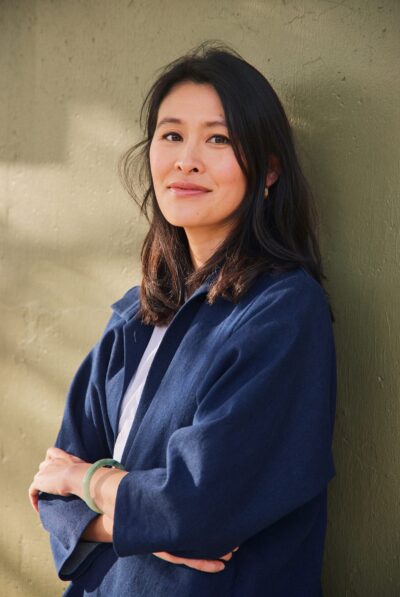
Rachel Khong is the author of Goodbye, Vitamin, winner of the California Book Award for First Fiction. Real Americans, her second novel, was a New York Times bestseller. In 2018, Khong founded The Ruby, a work and event space for women and nonbinary writers and artists in San Francisco’s Mission District. With friends, she teaches creative writing as The Dream Side. She lives in Los Angeles.
Photo credit: Andria Lo
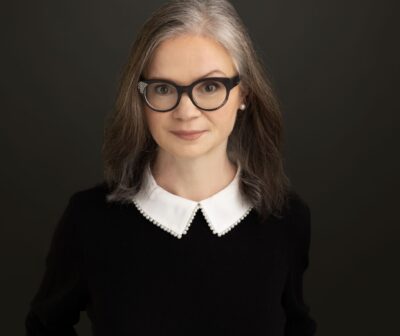
Marjee Chmiel is a writer, researcher, and documentarian in the Washington DC area. Her writing has appeared in The Masters Review, BULL, Maudlin House, and others. She is a social media co-director for Split Lip Magazine and the Presidential Fellow in fiction at George Mason University.
Photo credit: Angelique Hanesworth