Opera as the Original Drag Show: Sophie Strohmeier on her first novella, All Girls Be Mine Alone
by Cameron Engwall
On a particularly foggy evening downtown, I meet Sophie Strohmeier on a sidewalk, cars swimming around us, some leaving Manhattan and others returning to it. She’s generous enough to meet me after her day job and take me to New York’s oldest bar—an early 19th century haunt, boasting its history on myriad placards. We cozy up in the back, walls cluttered with art, tables covered in paper, with crayons available for scribbling. This feels like just the place where the characters of Strohmeier’s novella would gather, where opera students would drink away the oppressive cold, would let their guards down to welcome in the obscure, the strange, on their drunken and snowy walks home.
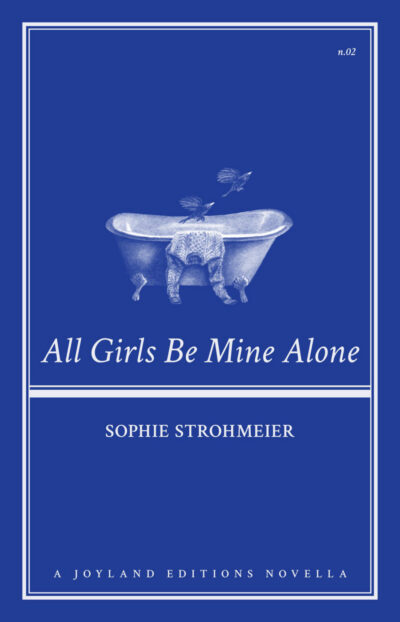
In All Girls Be Mine Alone, teenagers in Vienna discover monsters, possession, and desire, both in the classroom and out. The unnamed narrator’s sexual appetite grows more voracious over time, unable and unwilling to mask her queerness despite the judgment from her peers. What abounds is romantic competition laced in wit and humor—and a delightful, artful Gothic read.
While we absentmindedly doodle on the tables, Strohmeier shares how her Austro-American upbringing formed her writing, the inherent cultural intimidation in setting a project in another country, and how to write desire that feels palpable.
CAMERON ENGWALL: We were touching on the fact that this is your first book published originally in English. Can you walk me through that history a bit—specifically, the decision to write a novel predominantly in English and pursue publication that way?
SOPHIE STROHMEIER: I grew up in Austria, but my mother was American. My entire public life was German-speaking, but at home, with her, we spoke English. All of my literary language was English—I read in English, because there’s such a strong tradition of children’s literature in English. That became the language of my imagination. Even when everything around me was German, English was my private language. Whenever I wrote for myself, I wrote in English.
That said, I did write a novel in German. At the time, I was double majoring in French and Russian. A friend of mine worked for a publisher and encouraged me to pitch an idea. I pitched a lesbian novel—very trashy—about an Austrian girl who goes to Prague and discovers women there. Prague felt like this mythical and very feminine city, full of legends about great women and female warriors. I always knew I would keep writing. I published short stories, did film journalism—but I also knew I wanted to move to the U.S. to be closer to my mother. Applying for an MFA felt like the clearest path.
ENGWALL: Where was your mother living at that point?
STROHMEIER: New York State. I thought I understood the U.S. because I visited her, but of course I didn’t. I had this very European idea of American literature—the South, William Faulkner, Tennessee Williams, Carson McCullers. I was determined not to go to Iowa. I thought: it’s Alabama or nothing.
I ended up in Alabama, and the culture shock was enormous. Not accents, football, or bbq—but the way people talked about literature. I was accidentally mean in my first workshop because I thought I was being helpfully critical in the Austrian way. Still, I fell in love with Alabama and its many contradictions. I would have stayed if I’d found a job there.
ENGWALL: The South is deeply misunderstood, I feel–Alexis Okeowo and I talked about it regarding her book Blessings and Disasters: A Story of Alabama. It’s a place people see as a monolith from the outside, but it’s incredibly complex.
Did you start All Girls Be Mine Alone while you were there?
STROHMEIER: No. In Alabama I wrote another novel—technically done, but I’m letting the manuscript hibernate—and a lot of short stories. After I left, I moved to New York and worked in classical music management. Then the pandemic hit, I lost my job, and the following winter I sat in my room and wrote a novel.
That novel was about a classical music fan who works for an opera singer, and inside that novel was another novel. When the larger book didn’t work, I pulled the inner novel out and turned it into a short story, which was published in Joyland. Michelle King found it and asked if I wanted to expand it into a book. In a way, she commissioned All Girls Be Mine Alone. That kind of trust almost never happens.
ENGWALL: So this book went through several formal lives.
STROHMEIER: Yes—the characters and setting all lived in the same universe. My fear is always that things get worse when they get longer. I cut about seventy-five percent of the manuscript. Even now, I think I’d write it completely differently if I could—but I’m glad I can’t.
ENGWALL: I loved the first section—the love triangle—and I really missed Lea when she disappeared. I found myself oddly grieving her, which felt embarrassing given how quickly she exits the book. But it also felt right, like the novel was training me to experience attachment the way the narrator does—intensely, briefly, and without much warning.
STROHMEIER: Lea doesn’t really exist beyond the narrator’s mind. That’s my attempt at being Mozartian; that love is a construct of one’s own affects and identity. We build our identities through romance.
ENGWALL: The voice felt very Russian to me—Chekhovian, Bulgakov-esque. Things just happen and no one questions them. As a reader, I kept waiting for someone to step back and say, “This is strange,” and no one ever does. That refusal to explain felt like a real aesthetic commitment.
STROHMEIER: That’s exactly it. In Russian literature, the surreal is literal. Still, I would never write a book set in Russia. This book is a Viennese fantasy of Russia. I couldn’t responsibly write about the fall of the Soviet Union, and politically, especially given Russia’s war on Ukraine, it feels complicated to romanticize Russian culture. Russian opera, in particular, has been used as a cultural export of power, especially in the past 25-30 years. But I genuinely love Russian opera; the opera Eugene Onegin is almost more formative to me than the original poem, and this fascinates me.
ENGWALL: The book feels very queer without anyone naming queerness outright.
STROHMEIER: My opera environment was profoundly queer, especially lesbian, even if no one would have said so at the time. Fear, sexuality, gossip, folklore—all of that shapes queerness. Scholar Terry Castle wrote a whole book on how lesbians in modern literature frequently appear as apparitions, as ghosts, as things that must be proven to exist. That idea is central to the book. This invisibility, this spectral quality, felt like the register I wanted.
ENGWALL: I loved how unabashedly horny the narrator is. There’s something almost defiant about it—like the book refuses to sanitize desire or make it tasteful for the sake of literature.
STROHMEIER: I’m glad. Desire is often stripped of humor or directness in fiction and I wanted it to feel honest.
ENGWALL: Formally, I was struck by the short first section and the long second. As a reader, I kept thinking about imbalance—how longing often takes up very little space, and fulfillment takes up everything. Was that deliberate?
STROHMEIER: The first section is like an overture—or The Wizard of Oz. Black and white before color. It establishes longing. The second section is where the wish fulfillment happens. That imbalance is the point.
ENGWALL: One last thing I loved—the way you describe characters. Each gets one tiny, unforgettable detail.
STROHMEIER: Physical description is impossible. You never remember a whole face—just one or two things. I learned that through figure drawing. The narrator fixates, so she remembers obsessively small details.
ENGWALL: I want to ask a little more about Vienna itself, because it feels less like a backdrop and more like a psychic condition in the book. Reading it, I kept thinking about how certain cities don’t just shape behavior—they seem to shape thought. Vienna feels like that kind of place here. It’s oppressive, seductive, circular. How conscious were you of writing against Vienna while still being so bound to it?
STROHMEIER: Very conscious. Austrian literature, at least the tradition I come from, is deeply antagonistic toward Austria. There’s a chronic dissatisfaction—almost an agony—about being from there. You hate it, you can’t leave it, and even when you do leave, you carry it with you. That tension is foundational for me.
There’s an Austrian writer, Thomas Bernhard, who is extremely popular in the U.S. right now. He hated Austria more than anyone, and yet he could never fully escape it. His books are just relentless in their disgust with the country. I read one of his novels, The Loser, after I’d already written All Girls Be Mine Alone, and I was shocked by how close the emotional logic was—this idea of artistic failure, proximity to greatness, and self-destruction. It made me realize how deeply Austrian that impulse is.
ENGWALL: That sense of being trapped by place feels especially acute in the book’s relationship to art—especially music. Art is salvation, but it’s also suffocating.
STROHMEIER: Yes. Classical music culture is brutal and highly specialized, and in the current political environment of the US, it’s unsustainable. Most people who work in opera, highly trained singers and administrators alike, make minimum wage, but a big star like Yannick Nézet-Séguin, the Met’s artistic director, made over $2 million last year.
Opera itself is about power—many operas were written as assertions of power, to mark the event of a coronation or inauguration. At the same time, opera has become this intensely queer space—it’s been the home of gay men and lesbians since before that these identities were even configured. It’s a world that is communicated through practically immediate emotion, extremely earnest and ironic all at once. I see opera as the original drag show. That contradiction is fascinating to me: something so bound up with domination becoming a refuge for people who exist outside the norm.
ENGWALL: That contradiction feels central to the book’s erotic life, too. Desire here is never simple—it’s mediated by hierarchy, fantasy, projection.
STROHMEIER: Desire is almost never about the person in front of you. It’s about what they represent. The narrator is constantly misrecognizing people, especially men. She’s trying to want what she thinks she’s supposed to want. That’s why certain characters are described in such excessive detail—she’s studying them, trying to understand why everyone else sees something she doesn’t.
With women, the desire is more immediate, but also more frightening. There’s less distance. And fear and sexuality are always intertwined. People are often aroused by what scares them.
ENGWALL: That connects to something else I wanted to ask about: ghosts. The book is full of them—literal, metaphorical, emotional.
STROHMEIER: I’m very interested in ghost stories that aren’t supernatural. In Vienna especially, ghosts are just unresolved social facts. People disappear, die quietly, leave stains behind.
There’s a bar I’ve gone to since I was a teenager. There was always this man there—he was like part of the furniture. Last summer, he disappeared. It turned out he’d died in his bathtub above the bar. The water drained slowly, and over weeks it created a massive stain on the ceiling of the bar. That stain is still there. To me, that’s a ghost story. Nothing mystical—just the residue of a life that no one fully noticed.
ENGWALL: That feels very much in line with the book’s understanding of queerness, too—something that exists regardless of whether it’s acknowledged.
STROHMEIER: When I was in those opera environments, no one would have said the word “lesbian.” And yet the space was full of women traveling to see other women perform, forming intense attachments, building entire emotional worlds around those figures. Queerness doesn’t require naming to exist.
ENGWALL: I want to ask about your writing life now—especially because so many writers are trying to reconcile serious artistic ambition with the reality of full-time work.
STROHMEIER: The only way I wrote this book was by radically cutting down on my cultural consumption. I stopped watching movies. I cut my reading in half. And I also had a clear goal in mind. When you work nine to six and only have a couple hours at night, you can’t waste that time producing material you don’t care about.
I don’t believe in writing just to write; I think that’s terrible advice. If you only have a small window, you have to work on exactly what matters. Now, after finishing the book, I write only short journal pieces in the morning—three paragraphs, not pages. Sometimes it’s just thinking through why I loved or hated a movie or something I read. It keeps my critical brain awake.
Sophie and I get another round and proceed to talk through our favorite horror films—a list of arthouse recommendations on her end, a very honest suggestion of Smile and Smile 2 from me. I amble over to the bar and order the chicken pot pie I’ve been eyeing since arrival, imagining that the stain in the ceiling above me is water from a leaky bathtub.
Sophie Strohmeier is a bilingual writer and translator from Vienna, Austria. She is the author of the novella All Girls Be Mine Alone (Joyland Editions, 2025), as well as a novel in German, Küss mich, Libussa (edition a, 2013). Her English-language writing has appeared in Apofenie, Joyland, The Missouri Review, and Kenyon Review. She lives and works in New York City.
Cameron Engwall is a writer and editor living in New York. For more, visit cameron-engwall.com.